
botchedbydavid
Member
WARNING: DYOR!
What is BPC-157?
BPC-157 stands for “Body Protection Compound-157.” It’s a synthetic peptide (a short chain of just 15 amino acids) derived from a naturally occurring protective protein found in human gastric (stomach) juice. In essence, it functions as a signalling molecule: when introduced into damaged tissue, it appears to activate multiple healing pathways that help the body repair itself more efficiently.
not a single molecule ******.
BPC-157’s action of mechanism in an injury:
1. Promoting new blood vessel growth (angiogenesis): BPC-157 appears to stimulate the growth of new blood vessels through pathways involving VEGFR2 and nitric oxide, delivering more oxygen and nutrients to the injury site. This is particularly relevant because so many injuries (chronic Achilles tendinopathy, rotator cuff tears) occur in areas with inherently bad blood flow.
2. Boosting collagen production: The peptide activates fibroblasts, the cells responsible for producing collagen, the structural protein that forms the scaffold of tendons, ligaments, and other connective tissues. Animal studies suggest it works through specific cellular signaling pathways (FAK-paxillin and ERK1/2) to ramp up this repair process.
3. Reducing inflammation: Chronic inflammation can stall healing. This is something common in patients with tendinopathies that have been lingering for months. BPC-157 has demonstrated anti-inflammatory properties in laboratory studies, helping to calm the inflammatory response so that constructive repair can proceed.
4. Supporting muscle and nerve function: Beyond tendons and ligaments, research suggests that BPC-157 may stabilize the junctions between nerves and muscles, preserve acetylcholine receptors (the chemical messengers at nerve-muscle connections), and enhance muscle regeneration while reducing scar tissue formation. (Source: Maryland Orthopedic Specialists)
Diagram illustrating the molecular mechanisms by which BPC-157 promotes tissue regeneration, cytoprotection, and neuromodulation:
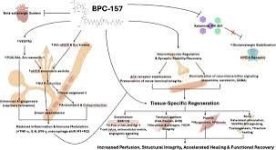
BPC-157 activates VEGF-dependent (via VEGFR2–PI3K–Akt–eNOS) and VEGF-independent (via Src–caveolin-1–eNOS) pathways to NO production, supporting angiogenesis, vasodilation, and vascular stability. It upregulates cytoprotective factors such as heme oxygenase-1 (HO-1) and heat shock proteins, preserving mitochondrial integrity and reducing oxidative stress. BPC-157 also restores glutamatergic signaling after NMDA receptor overactivation, and modulates adrenergic balance by counteracting beta-adrenergic overstimulation and blockade, preventing vascular occlusion-like syndromes. In endothelial cells, BPC-157 activates ERK1/2 signaling, enhancing proliferation, migration, and vascular tube formation through transcription factors like c-Fos, c-Jun, and Egr-1; ERK1/2 activation is required for its pro-healing effects both in vitro and in vivo, including in alkali-burn wound models.
TL;DR: BPC-157 modulates adrenergic balance, it supports angiogenesis, vasodilation, vascular stability, and it reduces oxidative stress.
Advantages of using BPC-157 After Injury(LIMITED HUMAN RESEARCH! MOST OF THE RESEARCH WAS DONE ON RATS!):
1. Tendon and ligament healing.
2. Muscle injury: Studies of muscle crush injuries demonstrated accelerated muscle fiber regeneration and repair of myotendinous junctions (where muscle meets tendon) within one to two weeks, with less scar tissue formation.
3. Bone healing.
4. Compromised healing environments: BPC-157 appeared to promote healing even in situations where recovery was impaired, such as tissues affected by corticosteroid use or areas with very poor blood supply. (Dr. Christopher S. Raffo’s conclusion).
4. Musculoskeletal Healing.
5. Athleticism and Performace.
Dosages:
Standard injectable BPC-157 dose: 250–500 mcg per injection, twice daily = 500 mcg – 1 mg total per day
What is BPC-157?
BPC-157 stands for “Body Protection Compound-157.” It’s a synthetic peptide (a short chain of just 15 amino acids) derived from a naturally occurring protective protein found in human gastric (stomach) juice. In essence, it functions as a signalling molecule: when introduced into damaged tissue, it appears to activate multiple healing pathways that help the body repair itself more efficiently.
not a single molecule ******.
BPC-157’s action of mechanism in an injury:
1. Promoting new blood vessel growth (angiogenesis): BPC-157 appears to stimulate the growth of new blood vessels through pathways involving VEGFR2 and nitric oxide, delivering more oxygen and nutrients to the injury site. This is particularly relevant because so many injuries (chronic Achilles tendinopathy, rotator cuff tears) occur in areas with inherently bad blood flow.
2. Boosting collagen production: The peptide activates fibroblasts, the cells responsible for producing collagen, the structural protein that forms the scaffold of tendons, ligaments, and other connective tissues. Animal studies suggest it works through specific cellular signaling pathways (FAK-paxillin and ERK1/2) to ramp up this repair process.
3. Reducing inflammation: Chronic inflammation can stall healing. This is something common in patients with tendinopathies that have been lingering for months. BPC-157 has demonstrated anti-inflammatory properties in laboratory studies, helping to calm the inflammatory response so that constructive repair can proceed.
4. Supporting muscle and nerve function: Beyond tendons and ligaments, research suggests that BPC-157 may stabilize the junctions between nerves and muscles, preserve acetylcholine receptors (the chemical messengers at nerve-muscle connections), and enhance muscle regeneration while reducing scar tissue formation. (Source: Maryland Orthopedic Specialists)
Diagram illustrating the molecular mechanisms by which BPC-157 promotes tissue regeneration, cytoprotection, and neuromodulation:
BPC-157 activates VEGF-dependent (via VEGFR2–PI3K–Akt–eNOS) and VEGF-independent (via Src–caveolin-1–eNOS) pathways to NO production, supporting angiogenesis, vasodilation, and vascular stability. It upregulates cytoprotective factors such as heme oxygenase-1 (HO-1) and heat shock proteins, preserving mitochondrial integrity and reducing oxidative stress. BPC-157 also restores glutamatergic signaling after NMDA receptor overactivation, and modulates adrenergic balance by counteracting beta-adrenergic overstimulation and blockade, preventing vascular occlusion-like syndromes. In endothelial cells, BPC-157 activates ERK1/2 signaling, enhancing proliferation, migration, and vascular tube formation through transcription factors like c-Fos, c-Jun, and Egr-1; ERK1/2 activation is required for its pro-healing effects both in vitro and in vivo, including in alkali-burn wound models.
TL;DR: BPC-157 modulates adrenergic balance, it supports angiogenesis, vasodilation, vascular stability, and it reduces oxidative stress.
Advantages of using BPC-157 After Injury(LIMITED HUMAN RESEARCH! MOST OF THE RESEARCH WAS DONE ON RATS!):
1. Tendon and ligament healing.
2. Muscle injury: Studies of muscle crush injuries demonstrated accelerated muscle fiber regeneration and repair of myotendinous junctions (where muscle meets tendon) within one to two weeks, with less scar tissue formation.
3. Bone healing.
4. Compromised healing environments: BPC-157 appeared to promote healing even in situations where recovery was impaired, such as tissues affected by corticosteroid use or areas with very poor blood supply. (Dr. Christopher S. Raffo’s conclusion).
4. Musculoskeletal Healing.
5. Athleticism and Performace.
Dosages:
Standard injectable BPC-157 dose: 250–500 mcg per injection, twice daily = 500 mcg – 1 mg total per day
- Conservative / beginner dose: 250 mcg once daily
- Standard healing dose: 250–500 mcg twice daily(morning + evening, 12 hours apart)
- Intensive / acute injury dose: 500 mcg twice daily (1 mg/day total)
- Maintenance / wellness dose: 250 mcg once daily
- Upper research range: 750 mcg twice daily(rarely used; reserved for severe acute injuries).
